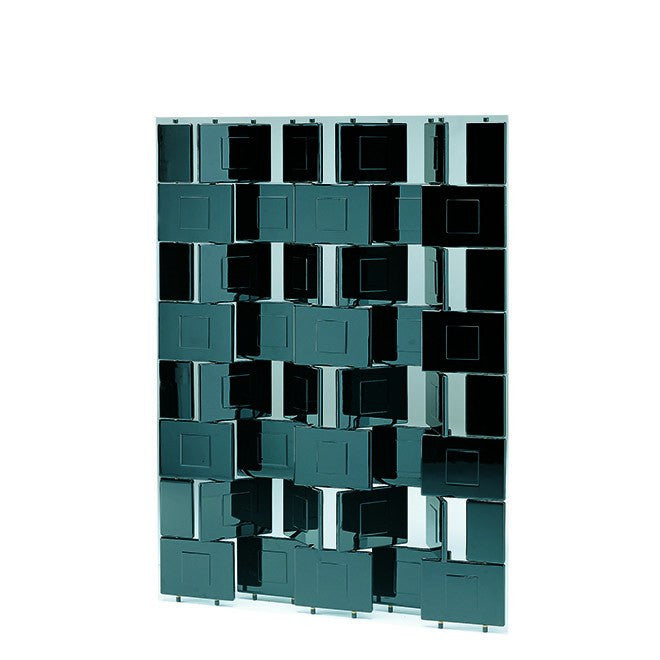
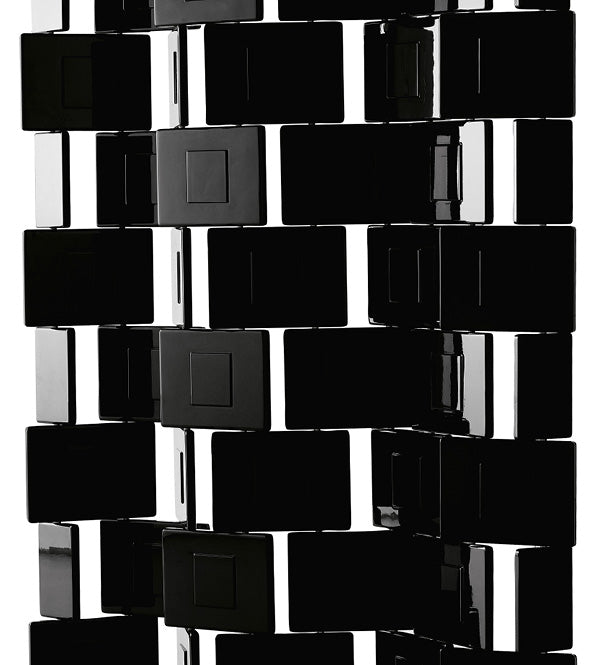
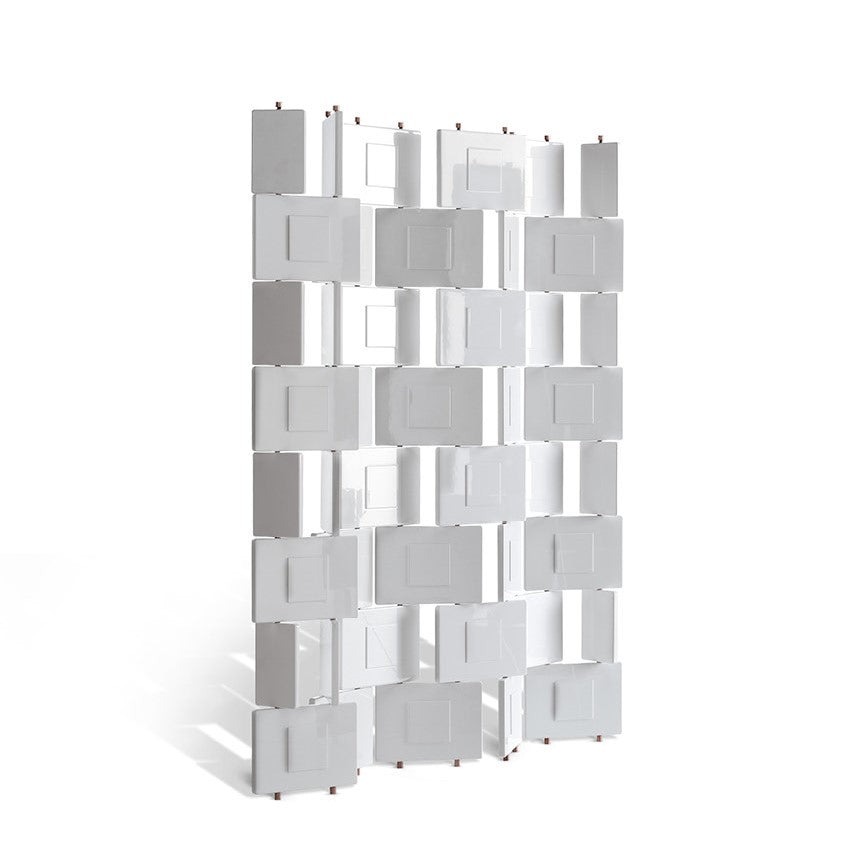
Eileen Gray Screen - Licensed Re-Editions by Alivar | Museum Collection
The Alivar Eileen Gray Screen is the only screen you will ever need. As a screen that doubles as an art piece, the Eileen Gray Screen is your best addition to any contemporary space. Made out of panels in medium density, structured with steel connecting rods and 'brass' hardware, and polyester finished in white or black. There are eleven versions of this screen that were produced at different times from 1922 up until 1971. Six are in black lacquer while five are in white. They vary in width and height. An example in the Virginia Museum of Fine Arts has plain panels. Others have a rectangular or square relief on one side of some or all of the large blocks. Eileen Gray was born in Enniscorthy in Ireland in 1878. She died in Paris in 1976. She was from an emigrant family and attended the Slade School in London, before finally moving to France in 1907. Following an initial experimental period with lacquers, she became increasingly involved in furniture design, and later in architectural projects. Her designs always being highly original and refined.

The inspired idea which is still today a guilding concept of Alivar originated in 1984 However the true origins go back to the 60's an era in which the creative works of modern design masters could only be seen in museums or specialized magazines.
The grand heritage of formal and functional design as expressed in furnishings and everyday domestic objects was seen in a new light thanks to the Werkbund initiatives the theories of the "Neue Sachlichkert" and the arts and crafts associations such as the British Arts and Crafts which provided a new insight into the dynamic merging of arts, crafts and industry.
It is on the basis of this stylistic intuition painstakingly refined and developed through the years which has led to the creation o i an extensive and coherent collection of designer furnishings, produced and distributed by the same company, ALIVAR The deep insight into the cultural spectrum of this century, and the search for those artists who best express contemporary tastes has led to the reproduction of the works of famous masters such as Mies Van der Rohe, Alvar Aalto, Marcel Breuer. featured in "The Classics of Modern Furniture" range. As well as the works of less well known artists, but equally valid and amazingly up-to-date, such as Jean Miche1 Frank. Takehiko Mizutani, Frederick Kiesler, Gerald Summers, Wassili and Hans Luckhardt, Isamu Noguchi George Nelson and Jules Leleu.
Philological accuracy is the basis of this master furnishing collection and the ALIVAR MUSEUM catalogue (featuring 230 products with bibliographic description, history of ihe originsand creative inspiration) has been transformed into a valuable book in its own right and will be distributed in bookshops as a source of reference and information; forming an anthology of higly elegant and formal furnishings throught time, which go beyond the limitations imposed by fashion and trends.
These furnishings ranges which are continually refined and updated on the basis of studies and research are further enhanced by the addition of new models each year which, while remaining faithful to the original designs in terms of the materials and forms, are now offered to the consumers of today.
Ludwig Mies Van Der Rohe Aquisgrana, 1886 - Chicago, 1969 Mies Van Der Rohe was trained at the studio of Peter Behrens (like Gropius and Le Corbusier) and he flourished under the influence of De Stijl, he was in 1930 nominated as the Director of the Bauhaus, as the successor of Annes Meier, a position that he occupied until its closure. He was not only responsible for truly revolutionary building designs, but of the furnishings often conceived for the same. The development of the Stockholm suburb of "Wessenhof" (1927),the fitting of the German exhibition hall at the International Exhibition of Barcelona (1929), the Tugendhat House project in Brno all being characterized by chair and armchair designs of the highly refined elegance.
|